Environmental Policy Tracker

Local and state policy is where environmental outcomes are actually decided. We follow what San Luis Obispo County officials and Sacramento are doing to protect or undermine our ecology.

Active Issue Updated 2023

Net Metering 3.0: California Guts Solar Incentives

Net metering has been one of the most effective tools for expanding rooftop solar in California. Under NEM 2.0, homeowners could pay off solar systems in roughly 10 years by selling excess electricity back to the grid at favorable rates. The credits were worth more, rolled over month to month, and made solar a genuinely attractive investment.

California's CPUC approved NEM 3.0 in early 2023 despite massive public opposition. The new rules dramatically reduce the value of exported solar energy, extending payback periods to 15 years or more for most homeowners. The policy effectively transfers value from distributed solar producers to investor-owned utilities.

On the Central Coast, the economic case for residential solar has weakened significantly under the new rules, but commercial and battery-paired systems can still be compelling. We're tracking local advocacy efforts and connecting residents with educational resources.
January 2022
CPUC proposes NEM 3.0 with deeply unfavorable export rates. Public outrage follows, including a 500-person protest Zoom call.
April 2023
Revised NEM 3.0 takes effect. Export rates cut by roughly 75% compared to NEM 2.0, effectively ending the payback economics that drove solar adoption.
Ongoing
Advocacy groups push for NEM reform. Battery storage and virtual power plant programs partially offset the cuts but require additional capital investment.

NEM 3.0: How California's policy change is halting solar adoption

Cory Jones discusses the push to ban styrofoam in SLO County communities

Progress Made Ongoing Enforcement

Styrofoam Bans: Local Wins, Enforcement Gaps

One With Nature collaborated with Surfrider Foundation and ECOSLO to advance styrofoam bans in SLO County communities. Expanded polystyrene is a particular problem because it breaks into microplastics that contaminate soil and water and are nearly impossible to remove once dispersed.

California enacted a statewide polystyrene food container ban that took effect in 2022. The challenge now is local enforcement and ensuring the ban extends to events, catering, and packaging sectors that often slip through enforcement gaps.

We continue to support organizations pushing for more complete implementation and for hydration station infrastructure that makes reusable options more convenient.

In Progress Active Partnership

Trail Signs & Open Space Protection

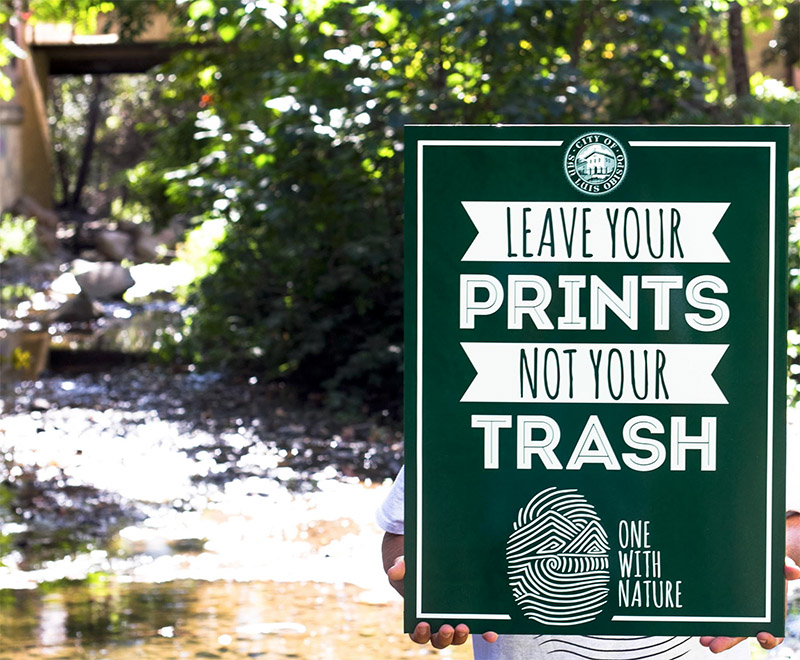
One With Nature is working with the City of San Luis Obispo to place informative hiking and cycling trail signs across the region's open space. The signs are designed to deter littering, limit user impact, and remind visitors of their relationship with the natural environment.

San Luis Obispo County has some of California's most accessible and biodiverse open space, from the Irish Hills Natural Reserve to Montaña de Oro State Park. Increasing trail use over the past decade has put new pressure on these ecosystems, particularly around parking corridors and popular beaches.

Signs are now present across multiple trail systems in the county. We're tracking the expansion of the program and pushing for interpretive content that connects visitors with the ecological significance of what they're walking through.

One With Nature hiking trail sign SLO County open space

Trail signage in place across SLO County open space to reduce litter and protect ecosystems

The Land Conservancy of SLO County: protecting open space and water resources

Active Campaign Infrastructure Push

Water Bottle Bans & Hydration Infrastructure

One With Nature has supported a local push to ban single-use water bottles in public spaces and fund the installation of hydration stations throughout the city's infrastructure. The goal is to make reusable alternatives genuinely convenient, not just theoretically preferred.

Single-use plastic water bottles remain one of the most common items found in coastal debris cleanups. A combination of retail restrictions and improved public access to refill stations is the most effective approach to reducing their prevalence.

Progress has been incremental. Some parks and public facilities in the area have added refill stations, but a comprehensive ordinance covering retail, events, and city-owned facilities has not yet passed. We're tracking the proposal and supporting advocates pushing for a full ordinance.

Your Voice Moves Policy

Contacting your local supervisor, showing up at public comment periods, and supporting organizations doing the work are all effective. Here's how to stay connected to what's happening.